When Should You File an Amended Tax Return and When Is It Better to Wait?
After filing a tax return, it is not unusual to discover new information later. A tax form may arrive late. Income may have been left out. A deduction or credit may have been entered incorrectly. When that happens, many taxpayers ask the same question.
Should I file an amended return now, or should I wait?
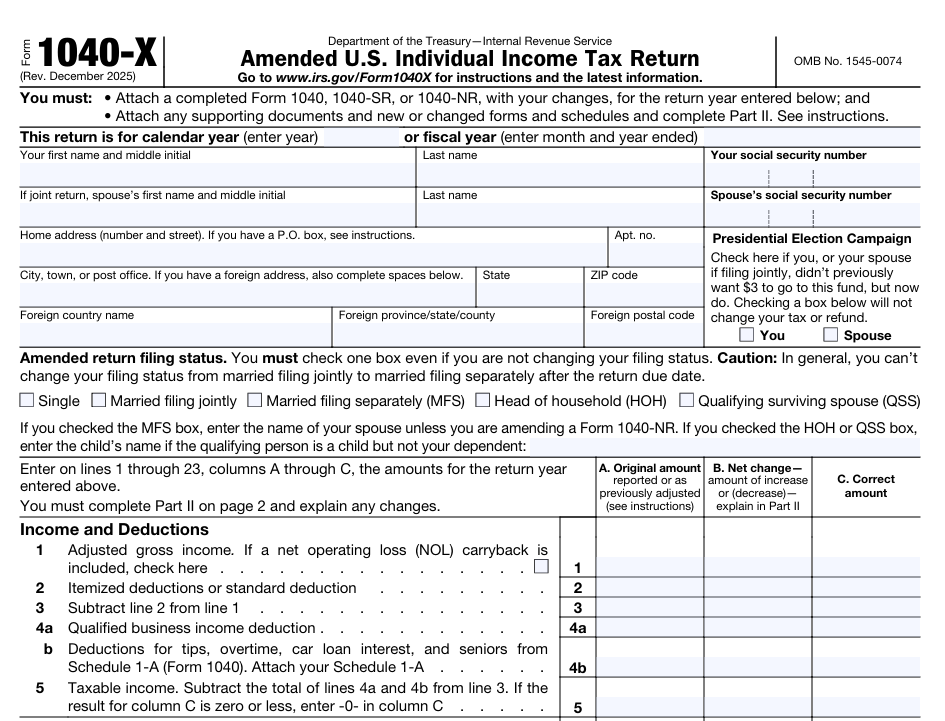
The answer depends on the type of issue and whether it changes the actual tax result. In general, Form 1040-X is used when the original return needs a meaningful correction, but not every mistake requires an amended return.
What Is an Amended Return?
An amended federal individual tax return is filed on Form 1040-X. It is used after the original return has already been filed and is generally used to correct important items such as filing status, income, deductions, credits, dependents, or total tax liability.
In other words, if the original return was materially wrong, Form 1040-X is often the proper way to fix it.
When You Should File an Amended Return
You should generally consider filing an amended return when the change affects the substance of the tax return.
- You missed taxable income
This is one of the most common reasons to amend. For example, you may receive a late Form 1099-INT, 1099-NEC, 1099-MISC, or brokerage Form 1099-B after the original return was filed. If the missing income changes your tax liability, filing Form 1040-X is usually the correct step.
- You claimed a deduction or credit incorrectly
If you forgot to claim a tax benefit you were entitled to, or claimed one you should not have taken, an amended return may be necessary. This includes situations where the correction changes the amount of tax due or the refund.
- Your filing status or dependent information was wrong
If you filed as Single but actually qualified for Head of Household, or if dependent information was incorrect, that can significantly change the tax calculation. In that case, an amended return is generally appropriate.
- You now owe additional tax
If newly discovered information increases the tax due, it is usually better to amend sooner rather than later. The IRS says taxpayers should pay additional tax as soon as possible to limit interest and penalty charges.
When It May Be Better to Wait
Not every issue requires an immediate amended return. In some situations, waiting is the better approach.
- The issue is only a math error
The IRS generally corrects math errors during processing. If the only problem is a basic calculation mistake, a Form 1040-X is usually not necessary.
- A required form or schedule was missing
If you forgot to attach a form or schedule, the IRS will often request it by mail. In that situation, you may be able to respond to the IRS notice instead of filing a full amended return.
- You are still waiting for corrected information
Sometimes a brokerage issues a corrected Form 1099 after the return was filed. In that situation, it may be better to wait until the final corrected information is available before filing an amended return. That can help avoid multiple amendments. This is a practical judgment call rather than a strict IRS rule.
- You are expecting a refund and the original return has not been processed yet
If you are filing an amended return that could affect a refund, the IRS says you should wait until the original return has been processed before filing Form 1040-X. Filing too early can create delays and confusion.
Practical Examples
Late brokerage statement
A taxpayer files the return in April, then receives a Form 1099-B in May showing additional investment income. If that new form increases tax due, filing Form 1040-X is usually the right step. It is generally better to correct the return and pay the additional tax than to wait for an IRS notice.
Corrected brokerage form still pending
A taxpayer files the return, then learns the brokerage may issue a corrected 1099. Instead of amending immediately, the taxpayer waits for the final corrected form so the return can be fixed once, not multiple times. That is often the more practical approach.
Forgotten schedule
A taxpayer forgets to attach Schedule A. The IRS later sends a letter requesting it. Instead of filing a full amended return, the taxpayer may simply respond to the IRS notice with the missing schedule.
Bottom Line
An amended return is usually appropriate when the original return reported important items incorrectly, especially income, deductions, credits, filing status, dependents, or tax due. But if the issue is only a math error or a missing attachment, the IRS may correct the return or request the missing item without requiring a Form 1040-X.
Before filing Form 1040-X, it is helpful to ask:
Does this change affect the actual tax result?
Will the IRS likely correct this on its own or request the missing item?
Has the original return already been processed?
Also remember that amended returns are subject to timing rules. In general, to claim a refund, you must file the amended return within 3 years after filing the original return or within 2 years after paying the tax, whichever is later. The IRS also says you can usually check amended return status about 3 weeks after filing, and processing generally takes 8 to 12 weeks, though some cases can take up to 16 weeks.
A careful review can save time, reduce unnecessary paperwork, and help avoid delays.
Note: This article is intended for informational purposes only and does not constitute tax advice. For personalized guidance, please consult a tax professional.