Tip Income and the New 2025–2028 Federal Tip Deduction
For 2025 tax returns, tip income rules largely remain the same — tips are still taxable and must be reported.
However, a new temporary law allows a separate federal income-tax deduction for certain tip income for 2025–2028.
1. What did NOT change
- All tips (cash, credit-card, pooled) are still taxable income
- Tips are still subject to Social Security and Medicare tax
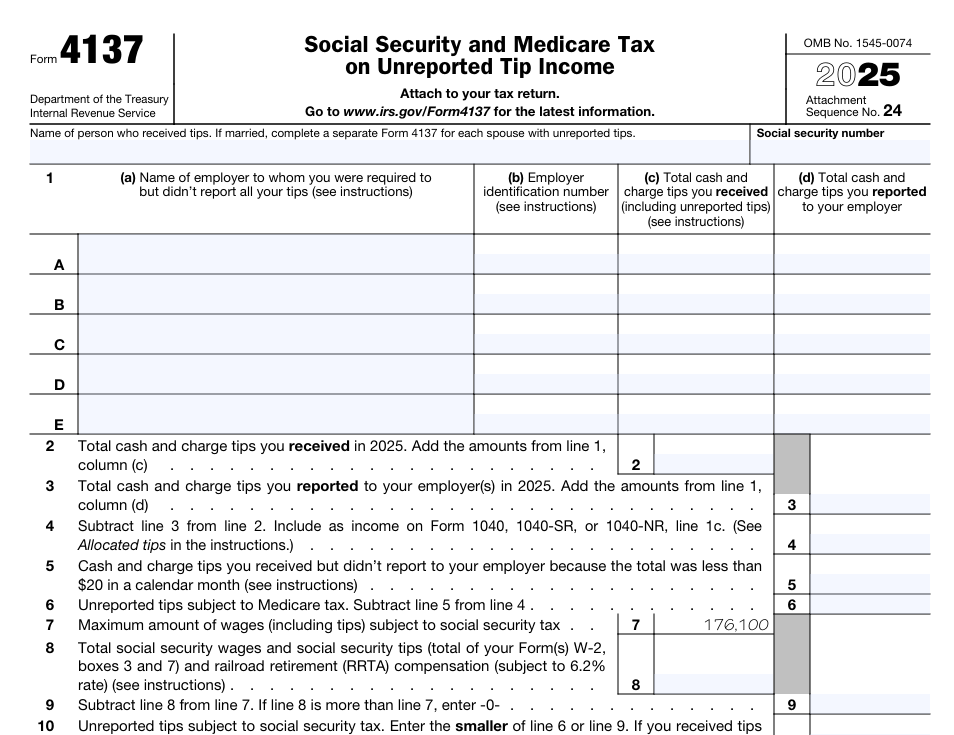
- Unreported tips still require Form 4137
- Self-employed workers still pay self-employment tax
2. What DID change for 2025–2028
A new qualified tip income deduction is available:
- Maximum deduction: $25,000 per year
- Available for employees and self-employed workers
- Subject to MAGI phase-out limits
- Not available to married filing separately
- Does NOT reduce payroll or self-employment tax
This is an income-tax deduction, not an exclusion from wages.
3. Where the tip deduction is claimed (important correction)
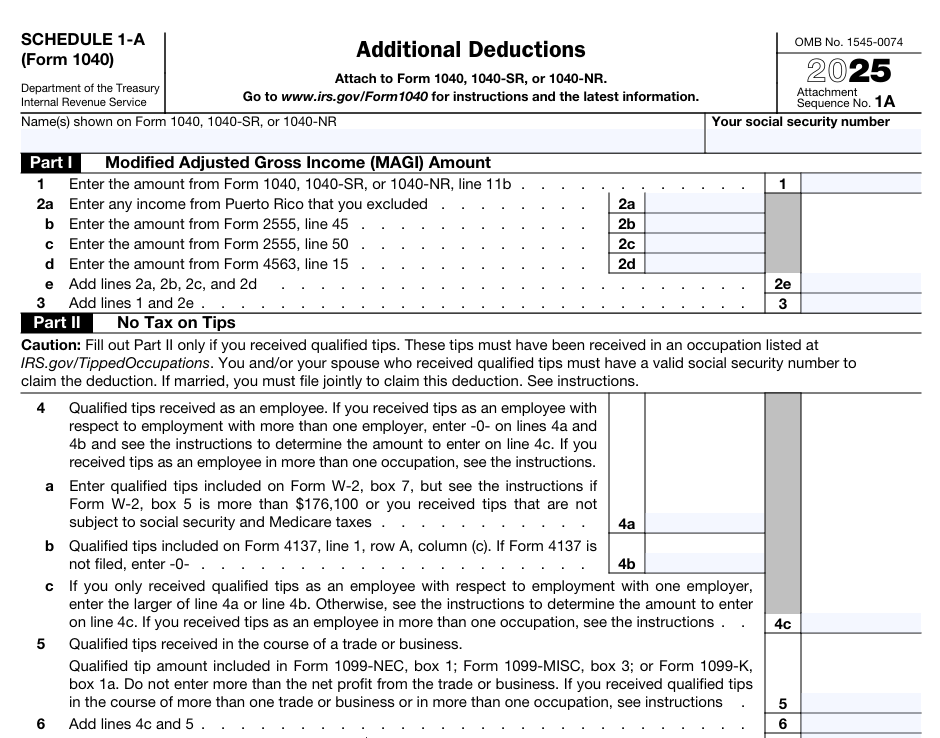
For 2025, the IRS places the tip deduction on:
- Form 1040
- Schedule 1-A – Additional Deductions
- Line designated for Qualified Tip Income Deduction (2025–2028)
Key point:
- Wages and tips are fully included in income first
- The deduction is taken after income is reported, through Schedule 1-A
4. Updated real-life examples (with correct forms)
Example 1: Mina — server who reported all tips
Facts
- $15,000 base wages
- $25,000 tips
- All tips reported monthly to employer
- W-2 correctly reflects all tips
Forms used
- Form W-2 → wages including tips
- Form 1040 → wages included in income
- Schedule 1-A (Form 1040) → claims Qualified Tip Income Deduction (up to $25,000)
What she does NOT need
- No Form 4137 (all tips reported timely)
Example 2: Daniel — bartender with unreported cash tips
Facts
- W-2 includes reported wages and card tips
- $5,000 cash tips not reported to employer
Forms used
- Form 4137
- Reports unreported tips
- Calculates additional Social Security and Medicare tax
- Form 1040
- Includes $5,000 in income
- Schedule 1-A (Form 1040)
- Claims Qualified Tip Income Deduction (if eligible)
Result
Daniel pays extra payroll tax via Form 4137, but may still deduct the $5,000 as qualified tips on Schedule 1-A, subject to limits.
Example 3: Lina — self-employed hair stylist
Facts
- Reports $30,000 gross receipts on Schedule C
- $10,000 of that amount is tip income
Forms used
- Schedule C → reports all income
- Schedule SE → calculates self-employment tax
- Form 1040 → includes net profit
- Schedule 1-A (Form 1040) → claims Qualified Tip Income Deduction (up to $10,000)
What she does NOT use
- No Form 4137 (not an employee)
Result
Lina still pays SE tax on tip income, but the deduction on Schedule 1-A reduces her taxable income.
Example 4: Marco — server with allocated tips (W-2 Box 8)
Facts
- W-2 Box 8 shows $3,000 allocated tips
Forms used
- Form 4137
- Reports allocated tips
- Calculates payroll tax
- Form 1040
- Includes allocated tips in income
- Schedule 1-A (Form 1040)
- Claims Qualified Tip Income Deduction (if eligible)
Result
Marco pays payroll tax on allocated tips but may reduce taxable income using the new deduction on Schedule 1-A.
5. Key reminders for 2025
- The tip deduction is not automatic
- It does not reduce Social Security or Medicare tax
- Tips must still be:
- Reported to the employer (employees)
- Included in gross income
- The deduction is claimed only on Schedule 1-A
Note: This article is intended for informational purposes only and does not constitute tax advice. For personalized guidance, please consult a tax professional.